Sourcing Aluminium Gates globally in 2026 requires more than comparing catalogue prices. Buyers must examine alloy grades, welding quality, coating systems, hardware performance, packaging, and factory consistency. A gate may look flawless in photographs, yet arrive with scratched powder coating or weak hinges. Small details become expensive problems.
Peter Kraljic, the procurement strategist, wrote, “Purchasing must become supply management.” His principle applies directly to Aluminium Gates sourcing. Reliable buyers should assess suppliers through documented production experience, material traceability, inspection records, and realistic delivery histories. A factory audit can reveal more than a polished website. Ask to see extrusion storage, welding stations, coating thickness tests, and packed-goods areas.
Do not chase the lowest offer.
In 2026, responsible sourcing also means checking energy use, recycled aluminium content, worker safety, export documentation, and applicable technical standards. Regional climate matters too. Coastal projects may require stronger corrosion protection, while cold regions need suitable seals and moving hardware. Supplier claims should be tested against samples, independent inspections, and signed specifications.
The process is not perfectly predictable. Freight disruptions, currency changes, and inconsistent batch quality can still affect landed costs. I would treat every quotation as a working estimate, not a promise. A strong sourcing plan therefore combines multiple qualified suppliers, clear acceptance criteria, pre-shipment inspections, and a practical contingency budget. Trust develops slowly. It should be earned through evidence, not attractive product images.
When sourcing aluminium gates globally in 2026, write the specification before requesting prices. Choose the alloy by function, not habit. A 6063 alloy suits clean, extruded profiles and moderate residential loads. A 6061 alloy offers higher strength for reinforced frames and heavy hinges. Ask suppliers for mill certificates, temper details, and dimensional tolerances. Small omissions become expensive.
Coatings need equal precision. Specify powder-coating thickness, pretreatment, colour tolerance, and testing method. For coastal sites, demand enhanced corrosion protection and documented salt-spray results. The Qualicoat technical framework provides useful benchmarks, although local approval may still differ. The International Aluminium Institute reports that recycled aluminium can require about 95% less energy than primary aluminium production. Therefore, request recycled-content data, but verify it through chain-of-custody documents. “Green” claims alone are weak evidence.
Security requirements should describe attack resistance, not vague phrases like “high security.” Define lock type, hinge protection, infill spacing, visibility, emergency access, and anchoring depth. Local building codes may control gate height, pedestrian safety, wind loading, fire access, and automated-gate sensors. The International Building Code and EN 13241 offer reference points, but neither replaces municipal review. Test the complete assembly, not only the aluminium section. A strong frame can still fail at the anchor plate. I would also question optimistic supplier drawings; installation conditions often receive too little attention. According to the U.S. Geological Survey’s 2025 Mineral Commodity Summaries, aluminium remains a major globally traded material, so documentation quality can vary sharply between regions. (Sources: International Aluminium Institute, Qualicoat, International Code Council, U.S. Geological Survey.)
| Specification Area | Recommended Requirement | Typical Data or Range | Why It Matters in Global Sourcing | Verification Documents |
|---|---|---|---|---|
| Primary gate alloy | Use an architectural aluminium alloy suitable for extrusion and outdoor exposure. | 6063-T5/T6 for clean profiles and moderate loads; 6061-T6 or 6005A-T6 for higher structural demand. Aluminium density is approximately 2.70 g/cm³. | Alloy and temper affect strength, weldability, surface finish, weight, and availability in the export market. | Mill certificate, alloy and temper declaration, chemical composition report, and tensile-property data. |
| Indicative mechanical performance | Specify minimum properties for the selected alloy and temper rather than relying only on the alloy name. | Typical minimum yield strength varies by product standard and temper; 6063-T5 is commonly lower than 6061-T6. Final values must follow the applicable material standard and certificate. | Different countries may use different product standards and temper designations, so certificates prevent material substitution. | Test report stating yield strength, tensile strength, elongation, alloy, temper, batch number, and standard used. |
| Gate configuration | Define pedestrian, single-swing, double-swing, sliding, or cantilever operation before quotation. | Typical clear opening: 900–1,200 mm for pedestrian access; 3,000–6,000 mm for vehicle access, subject to site design. | The opening type determines hinge loads, track requirements, motor sizing, foundation design, and shipping dimensions. | Dimensioned general arrangement drawing, installation orientation, handing, operating cycle, and site measurement record. |
| Profile and wall thickness | Set minimum profile section, wall thickness, reinforcement, and allowable deflection through structural calculations. | Common extruded gate components may use approximately 1.5–3.0 mm walls, but the correct value depends on span, infill, wind pressure, and hardware. | A nominal “heavy-duty” description is not a measurable requirement and can lead to inconsistent bids. | Section drawings, calculated bending and deflection results, profile tolerances, and sample inspection measurements. |
| Wind and structural loading | Require a site-specific wind-load calculation, including solid infill, perforated panels, mesh, and open-bar designs. | Wind pressure is project-specific and may be expressed in Pa or kPa. Open gates generally attract less wind load than solid gates, but local code governs. | Wind exposure, building height, terrain, cyclone or hurricane zones, and gate position vary significantly by country. | Structural calculation, design wind speed or pressure, support reaction loads, and fixing schedule. |
| Surface finish | Choose anodizing or powder coating according to exposure, color retention, appearance, and repair requirements. | Anodized finishes are commonly specified by anodic film thickness; powder-coated finishes should identify the applicable performance class and test requirements. | Coating terminology is not consistent across suppliers. A measurable standard reduces color, adhesion, and corrosion disputes. | Coating specification, batch record, color reference, gloss target, film-thickness readings, adhesion test, and sample approval. |
| Corrosion protection | Use a marine or high-corrosion-exposure system where the site is coastal, industrial, humid, or exposed to de-icing salts. | Specify pretreatment, coating system, drainage, sealed joints where appropriate, and compatible stainless-steel fasteners. | Galvanic corrosion can occur when aluminium contacts unsuitable metals in wet environments. | Pretreatment record, coating test results, fastener material declaration, salt-spray or cyclic-corrosion evidence where required. |
| Security level | Define the threat level and specify anti-lift protection, tamper-resistant fixings, lock protection, and hinge security. | Security requirements may range from basic residential privacy to controlled-access perimeter protection. No single gate material rating applies to every site. | A strong frame can still be vulnerable if the lock, hinges, posts, anchors, or access controller are underspecified. | Security schedule, hardware data sheets, forced-entry test evidence where required, and fixing/anchor details. |
| Automation and controls | Specify operator duty cycle, gate mass, leaf length, slope, travel speed, emergency release, and safety devices. | Include photoelectric protection, edge protection where applicable, manual release, obstacle detection, and safe stop or reversal functions. | Electrical supply, radio frequency requirements, safety rules, and installer qualifications differ by jurisdiction. | Operator calculation, wiring diagram, risk assessment, declaration of conformity, commissioning report, and maintenance instructions. |
| Pedestrian safety | Control crushing, shearing, trapping, impact, and uncontrolled movement risks. | Provide safe clearances, guarded moving parts, visible operating zones, and safety devices appropriate to the gate design. | Automated gates are machinery-like moving systems and may require formal risk assessment and documented commissioning. | Risk assessment, safety-function test results, operating instructions, warning labels, and inspection checklist. |
| Accessibility and egress | Confirm accessible clear width, threshold, opening force, controls, and emergency exit provisions with the local authority. | Requirements vary by building type and jurisdiction; accessible routes commonly require unobstructed passage and usable controls. | A gate that meets product dimensions may still fail accessibility, fire-egress, or emergency-access requirements. | Approved site plan, accessibility review, fire or emergency-access approval, and final opening-force measurement where applicable. |
| Europe and United Kingdom | Review the applicable machinery, construction-product, electrical, accessibility, and local planning requirements. | EN 13241 is relevant to industrial, commercial, and garage doors and gates; EN 12453 addresses safety in use for power-operated doors and gates. National adoption and amendments must be checked. | The required conformity route depends on whether the gate is manual, powered, integrated into a building, or supplied as a complete machine. | Declaration of conformity or incorporation as applicable, risk assessment, technical file, installation instructions, and local approval records. |
| United States and Canada | Check local building, zoning, electrical, accessibility, and automated-gate safety requirements. | UL 325 is widely referenced for door, gate, window, shutter, and operator safety; local codes may additionally govern wind, pool barriers, egress, and electrical installation. | Requirements can vary by state, province, municipality, occupancy, and hazard classification. | Listing or certification evidence where required, installation manual, site permit, electrical inspection, and safety-device test report. |
| Australia and New Zealand | Confirm requirements for powered gates, electrical equipment, wind actions, accessibility, and pool-barrier applications. | Applicable requirements may include AS/NZS 60335.2.103 for drives for gates, doors, and windows, plus building and electrical rules adopted locally. | Cyclonic regions and coastal exposure can require substantially different structural and corrosion specifications. | Electrical compliance documentation, wind design, installation certificate, safety test results, and local authority approvals. |
| Middle East and Africa | Assess heat, ultraviolet exposure, dust, sand, saline air, water scarcity, and local civil-defense requirements. | Use UV-resistant exterior finishes, sealed or protected bearings, suitable cable glands, dust protection, and corrosion-compatible hardware. | High temperature, sand ingress, and coastal salinity can reduce coating life and increase maintenance frequency. | Environmental exposure assessment, coating specification, ingress-protection data where relevant, maintenance plan, and local approval documents. |
| Latin America and Caribbean | Verify municipal permits, wind zones, electrical rules, coastal corrosion exposure, and emergency-access requirements. | Hurricane or high-wind locations may require reinforced posts, stronger anchors, reduced panel porosity, or engineered breakaway provisions. | National standards may be supplemented by municipality-specific construction and security rules. | Local engineer’s calculation, permit package, electrical approval, corrosion specification, and installation acceptance record. |
| Shipping and packaging | Define maximum package length, protection against abrasion, moisture control, labeling, and unloading equipment. | Long extrusions and assembled leaves may require custom crating. Protect finished surfaces from friction, trapped moisture, and impact. | International transport can damage coatings or distort frames before installation if packaging is not specified. | Packing specification, container-loading photos, dimensional packing list, moisture-protection method, and delivery inspection procedure. |
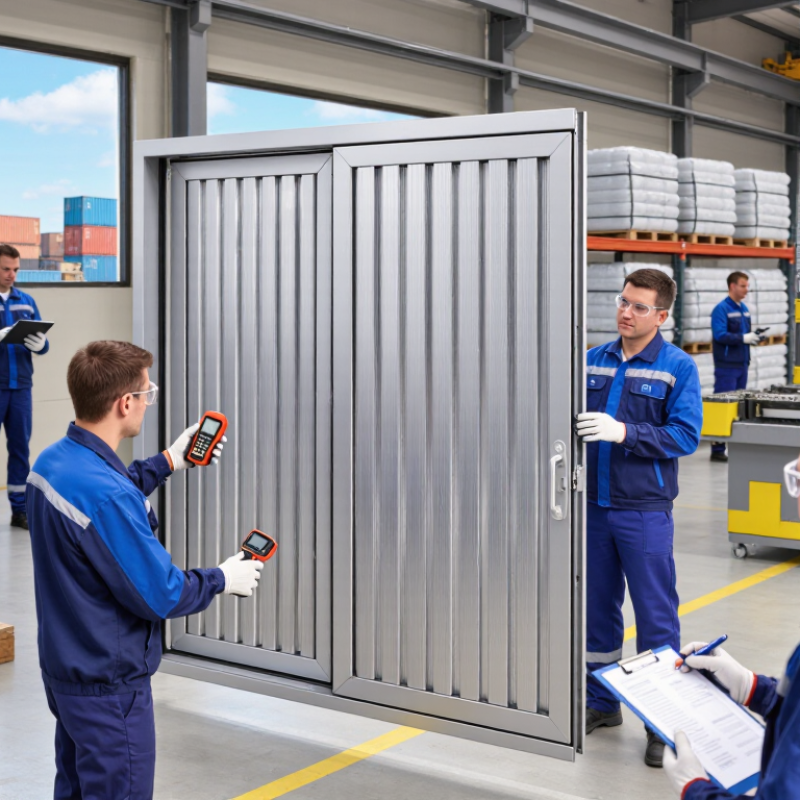
| Quality control and acceptance | Use approved drawings, first-article inspection, dimensional checks, finish inspection, functional testing, and site commissioning. | Inspect frame squareness, welds or mechanical joints, gaps, alignment, coating uniformity, hardware operation, limit settings, and safety functions. | A documented acceptance process makes supplier comparison and warranty decisions more objective. | Inspection and test plan, non-conformance procedure, final checklist, as-built drawings, warranty terms, and maintenance schedule. |
Choose the alloy by function, not habit. A profile alloy suits moderate residential loads. A stronger alloy suits reinforced frames and heavy hinges. Request mill certificates, temper details, and dimensional tolerances. Small omissions become expensive.
Specify coating thickness, pretreatment, colour tolerance, and testing methods. Coastal locations need stronger corrosion protection. Request documented salt-spray results. A bright finish can still fail early.
Define the lock type, hinge protection, infill spacing, visibility, emergency access, and anchoring depth. Avoid vague phrases like “high security.” Test the complete gate assembly. A strong frame may fail at its anchor plate.
Local rules may control height, pedestrian safety, wind loading, fire access, and automated sensors. Confirm requirements with the municipal authority. Reference standards cannot replace local approval.
Request current certificates, their exact scope, issuing details, and recent nonconformity records. Confirm aluminium fabrication is included. Ask for material traceability and production-control records. Certification alone proves little.
Walk through storage, cutting, welding, surface treatment, packing, and final inspection. Photograph profile heat numbers. Compare them with mill certificates. Check calibration labels and quarantine areas. Ask what failed last quarter. Honest answers may be more valuable.
Review reports for tensile strength, coating adhesion, corrosion resistance, and dimensional tolerance. Each report should identify the alloy, temper, sample size, laboratory, and test date. Match testing to climate and security loads. Documents can still be incomplete.
Include the product price, freight, duties, inland delivery, insurance, port charges, and storage risks. Compare delivery terms using identical quantities. Check tariff classification and origin documents. Add a sensitivity table for freight and carbon costs. The spreadsheet may still lie. Recheck everything before signing.
Sourcing Aluminium Gates globally in 2026 requires a structured approach that balances technical performance, compliance, cost, and sustainability. Begin by defining the gate’s alloy, surface coating, security features, dimensions, and installation requirements, while checking local building and safety codes. Next, assess supply capacity against global market conditions, including the approximately 70.6 million tonnes of primary aluminium produced in 2023. This helps buyers evaluate availability, lead times, and potential material risks.
Supplier qualification should include ISO 9001 quality systems, EN 1090 certification where relevant, ASTM-based testing, and independent factory audits. Buyers should also compare total landed cost under Incoterms 2020, including duties, freight, insurance, and potential 2026 CBAM-related obligations. Finally, sustainability should be managed through recycled content, efficient production, and transparent environmental data. Since aluminium recycling requires only about 5% of the energy used for primary production, selecting recyclable materials and responsible suppliers can reduce both environmental impact and long-term procurement risk.

 Qianyu