Choosing an Aluminum Banister is not just a style decision. It affects how a staircase feels under your hand, how a balcony edge is protected, and how much upkeep the railing may need. The International Aluminium Institute reports that about 75% of all aluminum ever produced remains in use. That figure reflects the metal’s durability and recyclability, but it does not guarantee that every railing will last. Finish quality, installation, weather exposure, and maintenance all matter.
Look closely at the details. Check the post spacing, handrail shape, connection hardware, and coating, especially if the banister will face rain or salty air. Ask whether the product has been tested for the loads and conditions relevant to your project. Building requirements vary by location, so confirm applicable rules with a qualified installer or local building professional. A polished showroom sample can hide weak fittings. Small details count.
The Aluminum Association reports that recycled aluminum requires about 95% less energy to produce than primary aluminum. That is useful context when comparing material options, though recycled content alone cannot tell you whether a particular product is safe or well made. Request clear specifications, warranty terms, and care instructions. Then compare the total installed cost, not just the price per section. I would also ask to see a real installation. Photos can be flattering. A sound choice balances appearance, verified performance, and practical maintenance—and admits when the product information is incomplete.
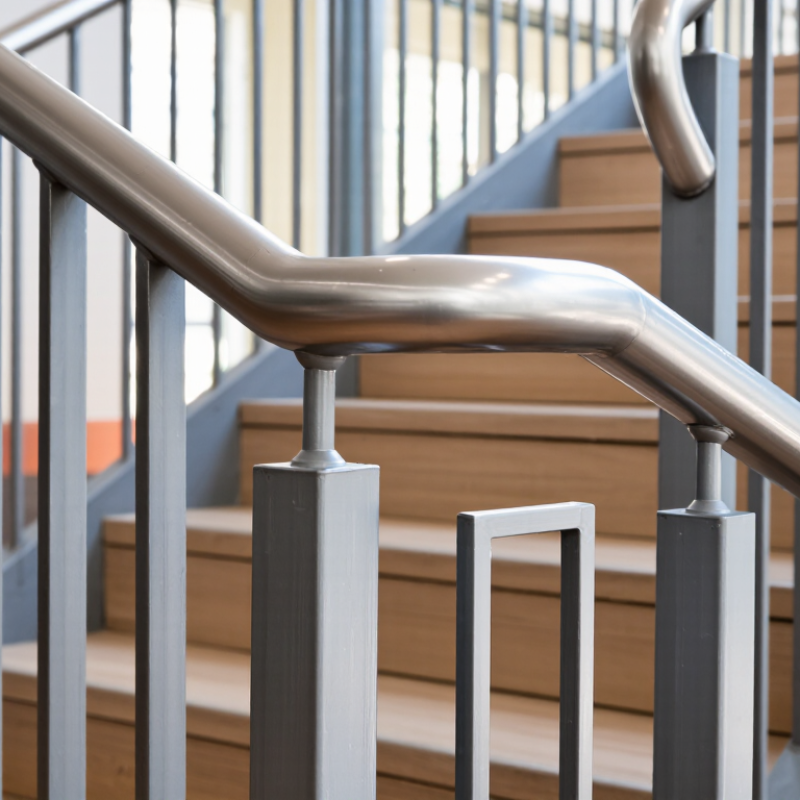
Choosing an aluminum banister starts with the load path, not the alloy name alone. ASTM B221-21 lists minimum tensile strengths of about 22 ksi for 6063-T5 extrusions and 38 ksi for 6061-T6; minimum yield strengths are about 16 ksi and 35 ksi, respectively. These are baseline values, not a guarantee for every profile. Product dimensions and applicable specification tables matter.
6063-T5 is commonly selected for architectural extrusions. It forms well and can provide a smooth finish, useful on rounded handrails and visible posts. 6061-T6 offers a stronger strength profile, which may help where posts, brackets, or spans face higher demands. More strength does not automatically mean a safer railing. Wall thickness, post spacing, fasteners, and the supporting structure all affect performance. Small details count.
The Aluminum Association’s Aluminum Design Manual provides guidance for designing aluminum members, including checks for strength and stability. Use it alongside the applicable building requirements and manufacturer test data for the exact assembly. A 6063-T5 rail with well-designed supports may outperform a poorly detailed 6061-T6 installation. That part is easy to overlook. Have the complete railing system reviewed for its intended loads, especially at corners and stair transitions.
6063-T5 has minimum tensile and yield strengths of about 22 ksi and 16 ksi. 6061-T6 rates about 38 ksi and 35 ksi. Stronger does not automatically mean safer.
6063-T5 is often chosen for architectural shapes and smooth finishes. It can work well on rounded rails and visible posts. Appearance still depends on the profile and finish.
No. Wall thickness, post spacing, fasteners, and the supporting structure all affect performance. A well-supported 6063-T5 rail may outperform a poorly detailed 6061-T6 installation.
For many stair applications, the common range is 34 to 38 inches above the stair nosings. Measure at several steps and check with a level line. Check twice.
Where the four-inch sphere rule applies, openings should prevent a sphere from passing through. Measure clear gaps between bars, not center-to-center distances. Check near posts and brackets.
Check edges, joints, and fastener openings for full coating coverage. Thin or damaged spots can expose the metal. A showroom finish is not the whole story.
Use compatible fasteners and look for drainage paths around posts. Salt, rain, and trapped moisture can accelerate deterioration. Inspect base plates for white residue or bubbling.
Wash it with mild soap and water, then inspect corners and hardware. Coastal settings may need more frequent rinsing. Dust collects; even careful inspections can miss a joint.
Choosing the best Aluminum Banister starts with matching material strength to the project. Compare 6063-T5, often selected for its balance of formability and strength, with the stronger 6061-T6 option when greater structural capacity is needed. Before purchasing, confirm that the complete railing system is designed for the required loads, including a 50 psf guard load and a 200-pound concentrated force, and check that these criteria suit local requirements.
Dimensions and long-term upkeep matter just as much. A handrail height of 34–38 inches and openings no wider than 4 inches can provide a useful starting point, but verify the applicable specifications for your installation. Consider powder coating, corrosion resistance, and routine maintenance when assessing durability. Finally, weigh the lightweight nature of aluminum, at about 2.70 g/cm³, against expected service life and total cost to choose a railing that offers lasting value.

 Qianyu